The construction industry is currently undergoing its most significant transition since the industrial revolution. We are moving away from “site-centric” traditional building toward “product-centric” assembly. This shift is defined as Modular Construction 2.0. At the heart of this movement is Volumetric Precast—the manufacturing of entire room-sized concrete modules, finished with MEP (mechanical, electrical, plumbing) and interior fixtures, before they ever reach the job site.
However, moving a 30-ton finished concrete “box” is fundamentally different from lifting a standard beam or a steel frame. As volumetric modules become more complex and heavier, lifting technology is evolving from simple mechanical hoisting into a sophisticated ecosystem of precision robotics and smart sensors.
The Challenge of the “Finished” Module
In traditional construction, lifting a structural element is about managing weight. In Modular 2.0, lifting is about managing delicacy. A volumetric precast module is a finished product. It contains windows, delicate cabinetry, and calibrated systems. A sudden jolt or a slight tilt during the lift doesn’t just risk structural cracking; it risks shattering glass and misaligning interior components.
Standard overhead gantry cranes often lack the “soft touch” required for this level of work. This has led to the development of specialized lifting tech designed specifically for the volumetric era.
1. Adaptive Spreader Frames and “Smart” Rigging
The most critical evolution in Modular 2.0 is the Automated Spreader Beam. Traditional rigging uses fixed-length wires that are difficult to adjust once the load is in the air. Volumetric modules, however, often have an offset Center of Gravity (CoG) due to internal heavy equipment or asymmetrical layouts.
Evolutionary Tech:
-
Self-Leveling Spreader Frames: Modern lifting frames now incorporate motorized counterweights or hydraulic cylinders that adjust the sling lengths in real-time. If the module begins to tilt by even one degree, the frame compensates automatically to keep the floor perfectly level.
-
Remote-Release Shackles: To improve safety and speed, high-rise modular projects now utilize radio-controlled hooks. This allows the ground crew to detach the rigging from the module once it is locked into place, eliminating the need for workers to climb onto the top of the module at dangerous heights.
2. From Tower Cranes to Specialized Gantry Systems
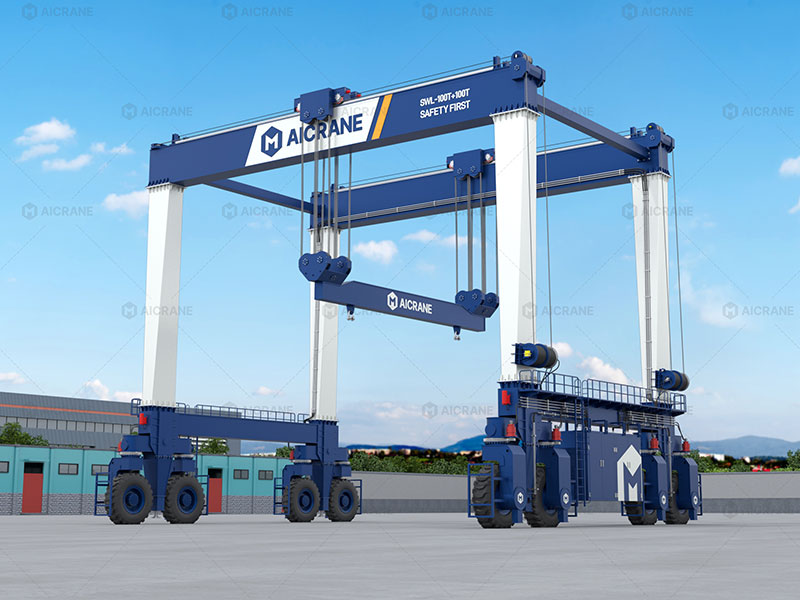
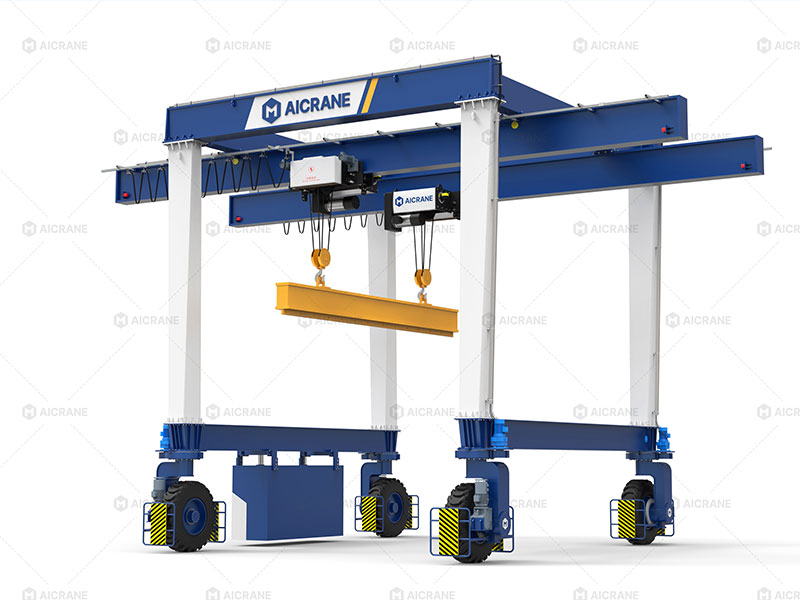
While tower cranes remain a staple for high-rise modular assembly, the “Modular 2.0” factory and the “staging yard” require a different breed of machine. The Rubber Tyred Gantry (RTG) Crane and the Straddle Carrier have been redesigned for the volumetric precast workflow.
Unlike traditional RTGs used in shipping ports, Industrial RTGs for modular construction are built with wider spans and precision-control steering modes (such as “crab steering” and “carousel turn”).
-
Zero-Clearance Mobility: These cranes can pick up a finished module from the factory door and navigate it through narrow storage lanes with only centimeters of clearance.
-
Integrated Weighing: Modern straddle carriers now include load cells that act as a final “Quality Control” check. If a module is supposed to weigh 25 tons but the crane registers 27 tons, it alerts the team to a potential error in the precast thickness or internal fittings before the unit is shipped.
3. Precision Placement: The Move to Millimeter Accuracy
The “2.0” in modular construction refers to the move toward high-density, high-rise urban infill. In these environments, modules are often slotted into a permanent steel or concrete “mega-frame.” The tolerance for error is often less than 5mm.
The Technological Shift:
-
Active Tugger Winch Systems: Wind is the enemy of modular placement. A single gust can turn a 20-meter-high module into a sail. New straddle carrier systems use computer-controlled tugger winches that apply counter-tension to the load, effectively “locking” the module in space and preventing any rotation or swaying, regardless of wind conditions.
-
Augmented Reality (AR) Guidance: Crane operators are now using AR overlays in their cabs. By looking at a screen or through a specialized visor, they can see a “digital ghost” of where the module is supposed to sit. This allows for precision placement even when the operator’s line of sight is obstructed by the building’s core.
4. Digital Twins and Lift Simulation
In Modular 2.0, the lift begins months before the crane arrives. Every volumetric precast module is designed as a BIM (Building Information Modeling) object.
Lifting technology now integrates directly with this data. Software can simulate the entire “flight path” of a module from the truck to its final position. This identifies “clash points” where the module might strike a scaffolding pole or an existing part of the structure.
By the time the actual lift occurs, the crane’s onboard computer already knows the optimal speed, swing radius, and set-down pressure required for that specific unit. This data-driven approach has reduced installation times by up to 40% compared to early modular attempts.
5. Safety and Fail-Safes in the Volumetric Era
As modules get larger, the consequences of a lifting failure become more catastrophic. Modular 2.0 equipment is defined by its redundancy.
-
Dual-Path Hydraulics: If a hydraulic line leaks in a modern lifting frame, a secondary system takes over instantly to prevent the load from dropping.
-
Anti-Collision Sensors: Straddle carriers and mobile gantry cranes used in modular yards are now equipped with LiDAR (Light Detection and Ranging). These sensors create a 360-degree safety bubble around the machine, automatically slowing or stopping the crane if a worker or a piece of equipment enters the danger zone.
6. The Impact on Sustainability
Lifting tech evolution isn’t just about speed; it’s about the environment. Traditional construction involves hundreds of smaller lifts (rebar, forms, concrete buckets), each consuming energy.
Volumetric construction consolidates these into a few “mega-lifts.” Modern Electric Straddle Carriers and hybrid cranes are now being deployed in modular factories to reduce the carbon footprint of the logistics phase. By optimizing the “travel path” of the crane through AI, energy consumption per module moved has been slashed significantly.
7. Looking Forward: Autonomous Lifting
The ultimate goal of Modular Construction 2.0 is the autonomous job site. We are already seeing prototypes of Autonomous Gantry Cranes that can move modules from factory storage to transport trailers without a human driver.
In the next decade, we expect to see “swarm” lifting technology, where multiple smaller robotic units work together to lift and position a single large volumetric precast unit, adjusting their grip and power output dynamically based on real-time sensor feedback.
Conclusion
The evolution of lifting technology is the “silent partner” in the success of modular construction. Without the ability to move, level, and place 30-ton finished rooms with the precision of a surgeon, the volumetric precast revolution would stall.
As we move deeper into the Modular 2.0 era, the boundary between “construction equipment” and “robotic systems” will continue to blur. The result will be a safer, faster, and more sustainable way to build our cities—one perfectly placed module at a time. For stakeholders in the precast and lifting industries, the message is clear: the future belongs to those who can master the heavy lift with the highest IQ.