The aggregate industry operates on a deceptively simple premise: crush rock, screen it, and sell the resulting fractions. Yet anyone who has commissioned a crushing plant knows that simplicity evaporates the moment specifications are drafted. Traditional plant design has long followed a monolithic philosophy—engineers calculate a target throughput, select equipment to meet that number, and then weld, bolt, and wire everything into a permanent configuration. This approach works admirably for operations with stable demand forecasts and no intention of expanding. But for the majority of quarry owners and contract stone crushers, the future is inherently uncertain. A new highway project appears unexpectedly.
A competitor exits the market, leaving unmet demand. A shift in product specifications requires additional screening stages. The monolithic plant, optimized for a single point in time, becomes a constraint rather than an enabler. Modular design offers an alternative paradigm. Instead of a fixed installation, the modular plant is conceived as a set of interchangeable, self-contained units—each performing a discrete function—that can be arranged, rearranged, and expanded as market conditions dictate. This approach does not merely reduce upfront capital expenditure; it fundamentally alters the risk profile of the investment, allowing operators to match capacity to demand incrementally rather than betting the business on a single, oversized installation. For the prudent operator, modularity is not a design preference. It is a financial hedge.
The Core Principles of Modular Crushing Plant Architecture
Decoupling Functions into Self-Contained Units
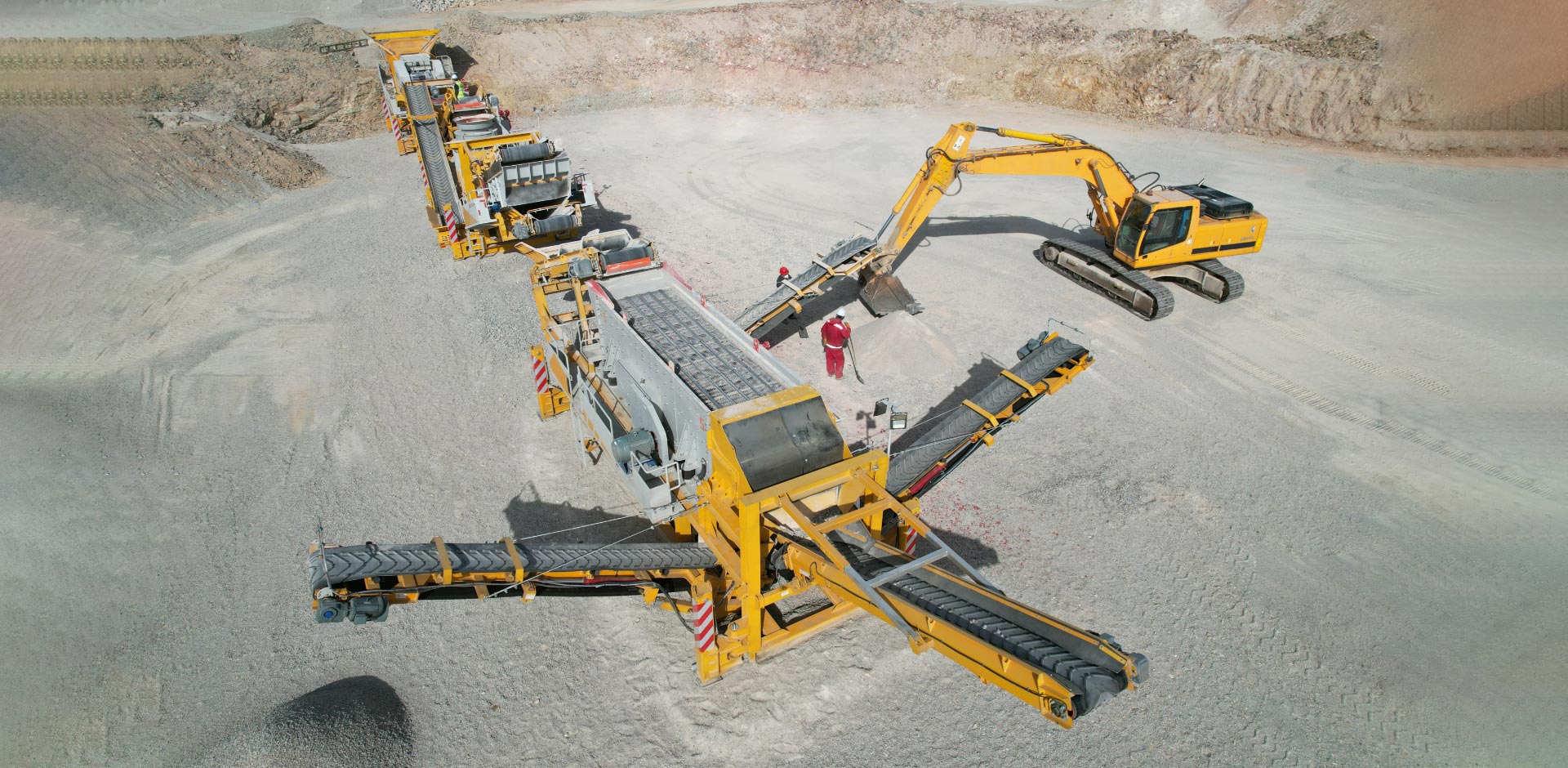
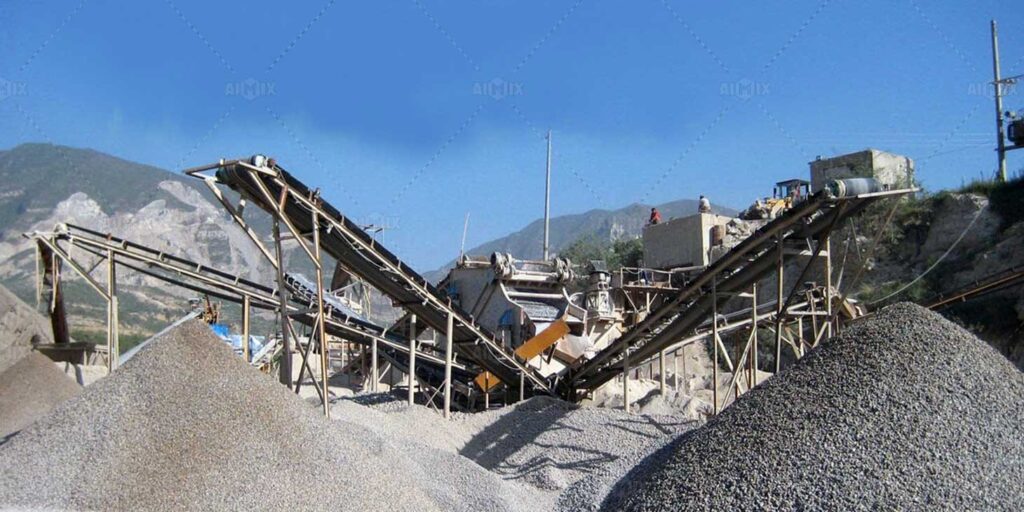
The foundational insight of modular design is that a crushing plant performs a sequence of discrete operations: feeding, primary reduction, secondary reduction, screening, conveying, and stockpiling. In a traditional layout, these functions are tightly integrated—the discharge chute of one crusher feeds directly into the next, with little provision for reconfiguration. Modular design inverts this logic. Each function is encapsulated within its own structural steel framework, complete with integrated conveyors, access platforms, and electrical controls. A primary crushing module contains the jaw crusher mobile, its vibrating feeder, and the discharge conveyor that transfers material to the next stage. A screening module contains the vibrating screen, its feed box, and multiple discharge chutes. These modules arrive at site as prefabricated assemblies, requiring only foundation pads and interconnection conveyors to become operational.
The decoupling yields two critical advantages. First, modules can be arranged in different configurations—parallel, series, or a combination of both—to suit the specific material characteristics and product requirements of each project. Second, and more importantly for future growth, individual modules can be upgraded or replaced without disrupting the entire plant. A secondary crushing module that becomes the bottleneck can be swapped for a larger unit while the primary and screening modules continue operating. This surgical approach to capacity expansion stands in stark contrast to the conventional practice of demolishing and rebuilding when throughput targets increase.
Standardized Interfaces and Interchangeability
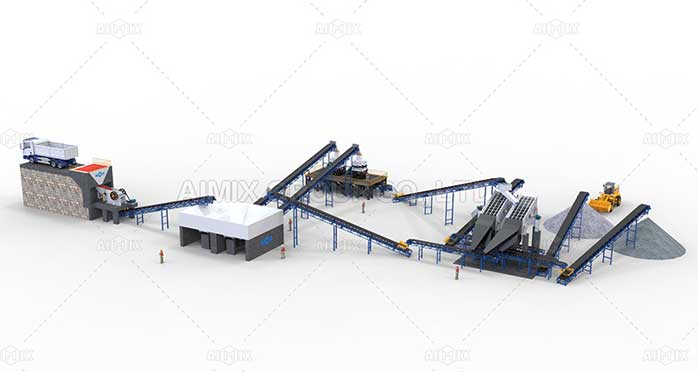
Modularity succeeds or fails based on the quality of its interfaces. A module is only as valuable as its ability to connect seamlessly with adjacent modules. The discipline of modular design therefore imposes rigorous standards for conveyor widths, discharge heights, and material transfer points. A well-designed modular system uses a common interface specification across all modules, meaning that a screening module from one production batch can be connected to a secondary crusher module manufactured three years later without custom fabrication. This interchangeability extends to electrical and control systems. Modules are equipped with standardized control cabinets and plug-and-play cabling that integrates with a central plant control system. The practical implication for plant operators is profound.
When market demand shifts toward finer products, an additional tertiary crushing module can be inserted between the secondary mobile cone crusher and the screens with minimal downtime. When a new quarry pit opens at a higher elevation, a portable feed module can be added to the front of the line. The plant evolves incrementally, without the stop-start disruption that characterizes traditional expansions. This capability to adapt without extensive re-engineering is the hidden value proposition of modular design, one that becomes increasingly apparent as the plant ages and market conditions diverge from original forecasts.
Cost Optimization Through Phased Capital Deployment
Matching Investment to Revenue Realization
The most immediate financial benefit of modular design lies in its alignment of capital expenditure with revenue generation. Traditional plant procurement requires the full investment—often millions of dollars—to be committed before the first ton of aggregate is sold. The modular approach permits a different sequence. An operator can begin with a primary crushing module and a single screening module, producing a limited range of products at a modest throughput. Revenue from this initial configuration funds the acquisition of a secondary crushing module, which unlocks additional product sizes and higher volumes. That increased revenue, in turn, finances a tertiary module or a second screening line.
This phased deployment transforms the financial structure of the project. Debt service obligations are lower during the initial ramp-up period when revenues are uncertain. Risk is contained because the capital at stake at each phase corresponds to the revenue already demonstrated. Furthermore, the modular plant can be sized not for peak demand but for the current demand level, with the understanding that additional capacity can be added in discrete increments as orders materialize. This is a fundamentally different financial model from the conventional approach, one that treats capacity as a variable cost rather than a fixed commitment.
Reduced Civil Works and Installation Expenses
Civil engineering represents a substantial portion of any crushing plant budget. Foundations must be designed for dynamic loads, graded for drainage, and constructed with reinforcement sufficient to withstand years of vibration. In a conventional plant, each piece of equipment requires its own foundation, designed and poured sequentially, extending the construction schedule and multiplying costs. Modular systems compress this expense through two mechanisms.
First, modules are designed with integral structural bases that distribute loads across a smaller footprint, requiring simpler foundations—often reinforced concrete pads rather than engineered substructures. Second, modules can be mounted on a common foundation raft, reducing the number of separate pours and allowing foundation work to proceed in parallel rather than series. Installation labor is similarly reduced. A module arrives with its crusher, feeder, and conveyors already aligned and bolted into place. The on-site work consists of positioning the module, connecting it to adjacent modules, and terminating electrical and control wiring. For operations in remote locations or regions with scarce skilled labor, this reduction in on-site work translates directly into lower installation costs and shorter commissioning timelines. The savings are not marginal; experienced contractors report that modular plants can be installed for 30 to 40 percent less in civil and labor costs compared to conventionally engineered equivalents.
Planning for Future Configurations and Technology Insertion
Anticipating Market Shifts Through Configurable Layouts
The aggregate market is not static. Specifications change as road construction standards evolve. Demand shifts between product sizes as infrastructure priorities change. A plant designed for maximum flexibility can respond to these shifts without major capital outlays. The modular plant achieves this flexibility through its configurable material flow paths. With multiple feed and discharge points on each module, the operator can redirect material flow by repositioning transfer conveyors rather than cutting and welding chutes.
A plant configured for closed-circuit crushing—where oversize material returns to the rock crushing machine—can be reconfigured for open-circuit operation in a matter of hours. A screening module that originally produced three products can be fitted with different screen media to produce four products. This configurability is not an afterthought; it is designed into the system from the outset, with provision for additional conveyor connections and spare control capacity in the electrical system. The operator who invests in a modular plant is not purchasing a fixed production line. They are purchasing a platform for production, one that can be reconfigured as the market dictates, preserving the value of the initial investment through multiple operational phases.
Accommodating New Technologies Without Obsolescence
Technology in the crushing industry advances continuously. Automated crusher setting systems improve product consistency. New screen technologies increase throughput. Sensors and telematics enable predictive maintenance. In a conventional plant, adopting these technologies often requires significant retrofitting or, in the worst case, replacement of entire sections of the plant. The modular architecture insulates the operator from this obsolescence risk. Because each function is contained within its own module, upgrading a single function does not require modifying adjacent modules. A primary crushing module with an older jaw crusher can continue operating while a new secondary module with automated settings is added downstream.
A screening module can be replaced with a higher-capacity unit without touching the crusher modules. This technology insertion capability extends the useful life of the plant and protects the operator from the rapid depreciation that affects conventional installations. For the long-term operator, the ability to adopt new technologies incrementally—deploying capital only where the return is clearest—represents a substantial advantage over competitors locked into monolithic designs. The modular plant is not merely a cost optimization strategy. It is a bet on the future, one that acknowledges that the only certainty in the aggregate business is change itself.